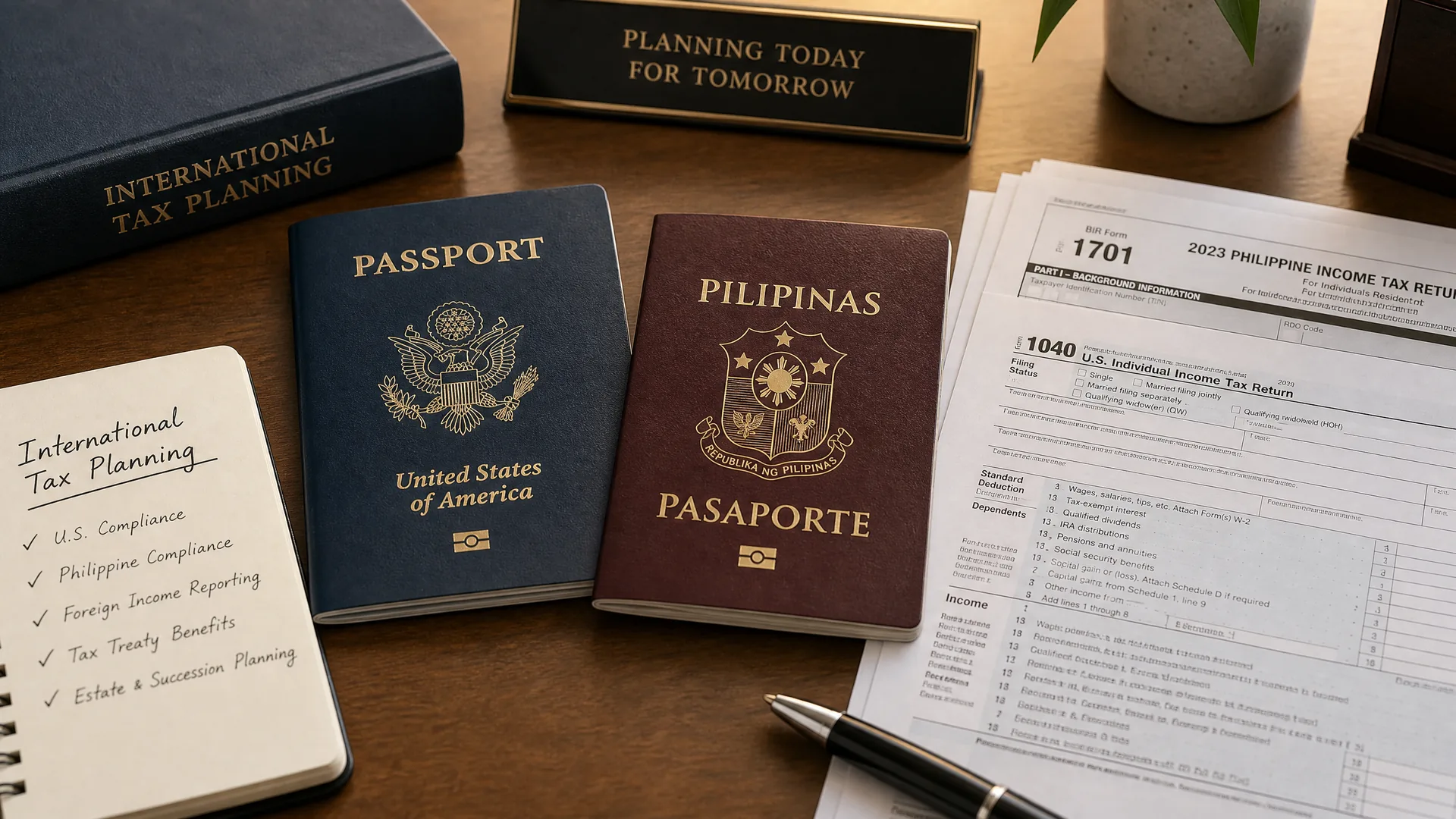
Americans have a uniquely frustrating relationship with international tax planning, and pretending otherwise helps no one. The United States taxes its citizens on their global income regardless of where they live. It is one of only two countries on earth that does this, the other being Eritrea. There is no clean break, no quiet exit. Move to the Philippines and you are still a US taxpayer.
So let us be precise about what a Philippine base does and does not do for an American, because the real advantages are substantial and the false promises are dangerous.
The Foreign Earned Income Exclusion
If you are a US citizen living abroad and you meet either the bona fide residence test or the physical presence test, you can exclude a portion of your foreign earned income from US taxation. For 2026 the exclusion is approximately USD 132,900 per person. It applies to earned income, meaning salary and self-employment income, the money you actively work for.
The bona fide residence test is the one a genuine Philippine base supports. It requires real residence in a foreign country, established and documented: a real apartment, a real visa or long-stay status, a verifiable presence. This is exactly what a properly built base provides. The lease in your name, the TIN, the BIR registration confirmation, the ACR card, these are not just administrative trophies. They are the evidence that backs a bona fide residence position.
We produce the documents. Your US CPA files the exclusion. That division of labour matters, and we will come back to it.
What the FEIE does not cover
Here is where people overreach. The FEIE applies to earned income only. It does not cover passive income: dividends, interest, capital gains. Americans pay US tax on passive income no matter where they live.
The Philippine territorial system does not create a US exemption. It means you pay no Philippine tax on your foreign passive income, which is a real saving against double taxation, but the US layer remains. Anyone who tells you a Philippine move makes your US capital gains disappear is either confused or lying. The honest pitch is better than the false one: you remove the Philippine tax entirely and you shelter a large slice of earned income through the FEIE, while remaining fully compliant on the rest.
The Foreign Tax Credit
Because Philippine tax on local income is generally lower than US rates, the FEIE is usually the better tool than the Foreign Tax Credit for earned income. The FTC tends to earn its place on passive income where some foreign tax has actually been paid. Which lever to pull, and in what combination, depends on your specific income mix, and it is a question for your US tax adviser, not a website.
FBAR and FATCA: report, do not hide
Two obligations every American with a foreign account needs to internalise.
The FBAR (FinCEN Form 114) is required if your aggregate foreign account balances exceed USD 10,000 at any point in the year. Your Philippine account counts. Your Singapore account counts. The penalties for non-filing are severe, and they are entirely avoidable by simply filing.
FATCA is the US framework that sits separate from CRS. The practical lesson is simple: as a US person, you must assume your accounts can be seen and, regardless, that you are obliged to report them yourself. The Philippines being outside CRS is irrelevant to your US duties. Do not treat any account as invisible to the IRS. Plan as if everything is reportable, because for you it is.
Pensions and Social Security
US Social Security and 401(k) or pension distributions remain taxable in the US. The Philippines does not tax foreign-sourced pension income for a Resident Alien, so there is no Philippine layer on your retirement income, but the US layer continues as normal. No surprises, in either direction.
Our position on American clients
We are not US tax advisers, and we will never pretend to be. What we do is build the genuine Philippine base, with the full documentation required to support a bona fide residence position and an FEIE claim, and we work alongside your existing US CPA or tax attorney. If you do not have one, we introduce you to advisers who specialise in American expat taxation.
The American who benefits most from a Philippine base is the one who goes in clear-eyed: no Philippine tax on foreign income, a large earned-income exclusion through the FEIE, full and cheerful compliance on everything else, and a real residence that stands up to examination. Done that way, the advantages are genuine and durable. Done on the basis of disappearing from the IRS, it ends badly. We only do it the first way.
Ready to build your Davao base?
Order services directly, or book a call with Tim to discuss your situation first.