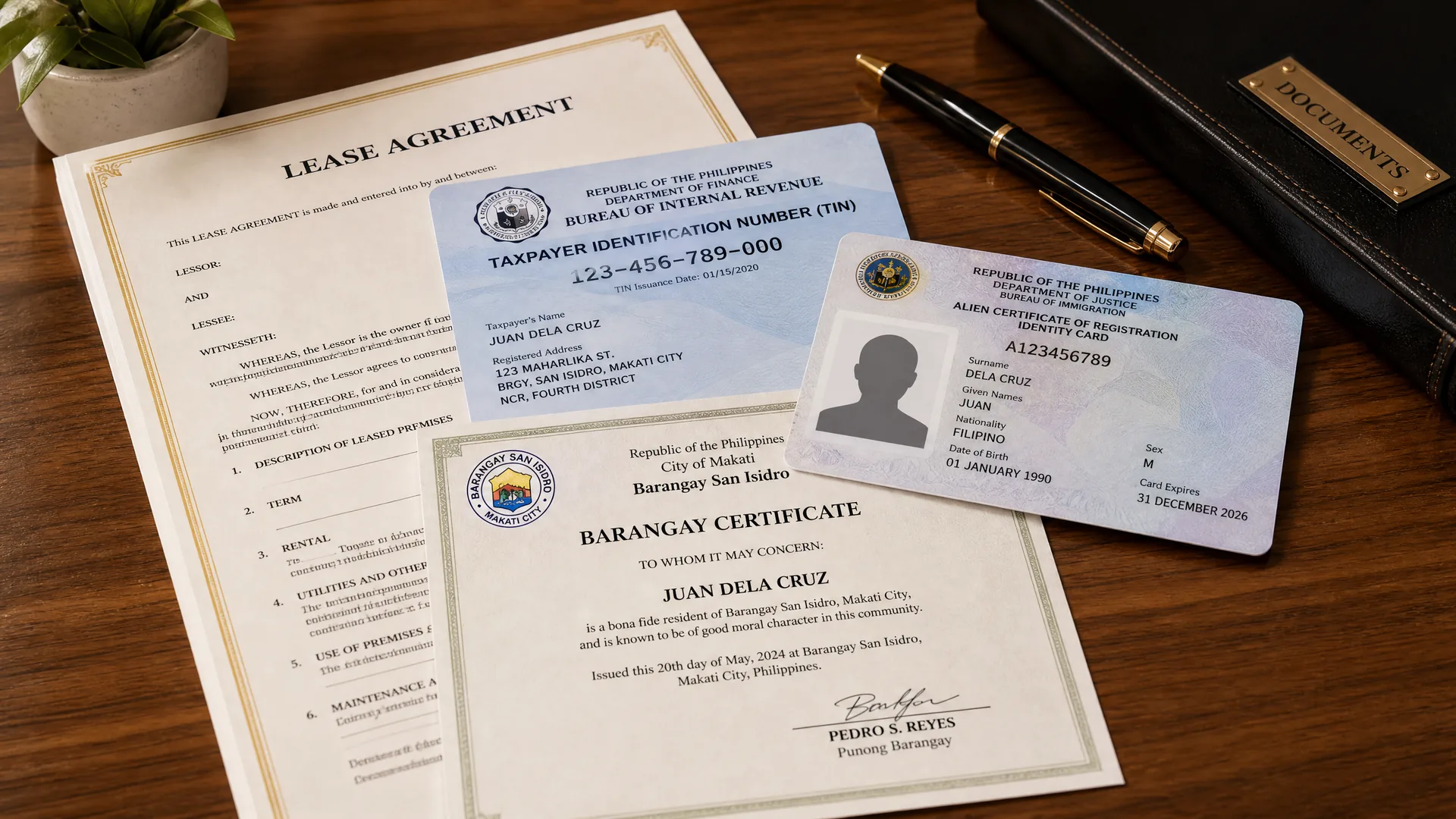
There is a large difference between having an address in the Philippines and having a residence in the Philippines. The first is a line on an envelope. The second is a position that holds up when a bank's compliance officer, a foreign tax authority, or a notary decides to look closely. That difference is the whole game, and it is worth being precise about what the real version contains.
The complete document set
A genuine Philippine residency, the kind that survives scrutiny, is built from these pieces:
1. A signed lease agreement
In your name, for a real apartment. Not a flat-share, not a serviced office, not a mailbox with forwarding. A residential lease for a specific property, signed by you and the landlord, stating your name and the address.
2. Utility accounts in your name
Electricity and water registered to you at the leased address. These are routinely used by the BIR and banks as secondary proof that you actually live where your lease says you do.
3. A Philippine Tax Identification Number (TIN)
Issued by the Bureau of Internal Revenue, this is your formal entry into the Philippine tax system. Almost every later step depends on it: the bank account, the ACR I-Card, the BIR registration.
4. A BIR registration confirmation
The official document confirming you are registered for tax in the Philippines as a Resident Alien. This is what banks and most authorities want to see at the base-setup stage. Note the distinction: a Certificate of Tax Residency is a separate document issued later, for use in treaty claims and formal correspondence with foreign tax authorities. The BIR registration confirmation is the foundation document.
5. A Barangay Certificate
Issued by your local barangay, confirming your residence at the community level, the ground-floor government authority for your address. Many banks and immigration steps ask for it specifically.
6. An ACR I-Card
The Philippine government's identity card for foreign residents, required after 60 days of continuous stay. It carries your photo, name, nationality, and registered address, and is accepted as identification by banks and government offices across the country.
7. Your visa documentation
Whether a tourist extension, SRRV, SIRV, or 9G, this is the formal immigration document authorising your presence.
Why the whole set matters
Take any single document and it proves little. Take them together and they become something a postal address can never be.
- •A mailbox with forwarding satisfies none of these requirements.
- •A shared apartment not in your name satisfies very few.
- •A serviced-office address is recognised on sight by any experienced compliance officer.
The reason the full package holds up is that each document is issued by a different Philippine government authority, from the national BIR down to your own barangay, and together they tell a single, consistent, verifiable story. A bank cannot easily dismiss a lease, utilities, a TIN, a BIR confirmation, a Barangay Certificate, an ACR I-Card, and a visa that all agree with one another.
That consistency is the asset. It is the difference between a residence you can point to and one you can actually rely on.
This is what we produce for every client. Not a theory of residency. The documents themselves.
Ready to build your Davao base?
Order services directly, or book a call with Tim to discuss your situation first.